How Much Shed Foundation Material Do I Need?
A stable, properly planned foundation supports shed performance, but quantities depend on the selected method. Gravel ordering starts with finished compacted depth, while loose delivery volume is larger; concrete follows entered slab geometry; and skid or support quantities come from a confirmed layout. To estimate shed-foundation materials, multiply the foundation area by the compacted gravel depth or concrete thickness, convert the result to cubic yards or cubic meters, and add compaction and waste allowances. For a block or pier layout, multiply the user-confirmed support rows by the supports per row and the units per support. The free Shed Foundation Calculator estimates materials but does not design or approve a foundation.
Watch: Estimate Gravel for a 12 × 10 Shed
Follow the 94-second, text-led tutorial using the diagrams and calculator from the worked example below. See how a sample 14 × 12 ft pad becomes a gravel estimate, and why the supplier order can differ from the rounded display. No audio is required. Confirm dimensions, depth and allowances for your project.
Free Printable Shed Foundation Worksheet
Take this two-page gravel-pad worksheet to your measurement session or supplier. It includes a top-view sketch, blank measurement fields, imperial and metric volume formulas, compaction and waste allowances, a quote checklist, a partial material budget and a checked example. Print it on US Letter paper and fill it in by hand; no sign-up is required.
Start with foundation dimensions and finished depth confirmed for your project. Record each extension separately, choose one unit system, and confirm whether your supplier has already included compaction or waste. Use the calculator for the arithmetic, then record the supplier-confirmed purchase quantity and price on the worksheet. Supplier minimums and order increments can change the final cost.
The worksheet covers a gravel pad. Use the calculator and the sections below for concrete, skid or support-grid estimates. Neither the worksheet nor the calculator selects or approves a foundation design.
Open or download the shed foundation worksheet (PDF, 2 pages)
Calculate your shed foundation quantities and material budget
What to Record Before Ordering Gravel
| Step | Record | Check |
|---|---|---|
| Measure | Shed length and width; front, back, left and right extensions | Pad length = shed length + front + back; pad width = shed width + left + right. |
| Estimate | Finished depth, compaction allowance and waste allowance | Convert depth to the same length unit before calculating volume. Do not count supplier allowances twice. |
| Quote | Material specification, purchase unit, quantity, unit price and delivery | Confirm minimum load, order increments, access, fees and tax. Use supplier loose density if buying by weight. |
| Budget | Gravel, planned accessories, delivery, fees and contingency | Separate material estimates from labor, excavation, equipment, drainage, permits and other unquoted work. |
Worked Example: A 12 × 10 Shed Gravel Pad
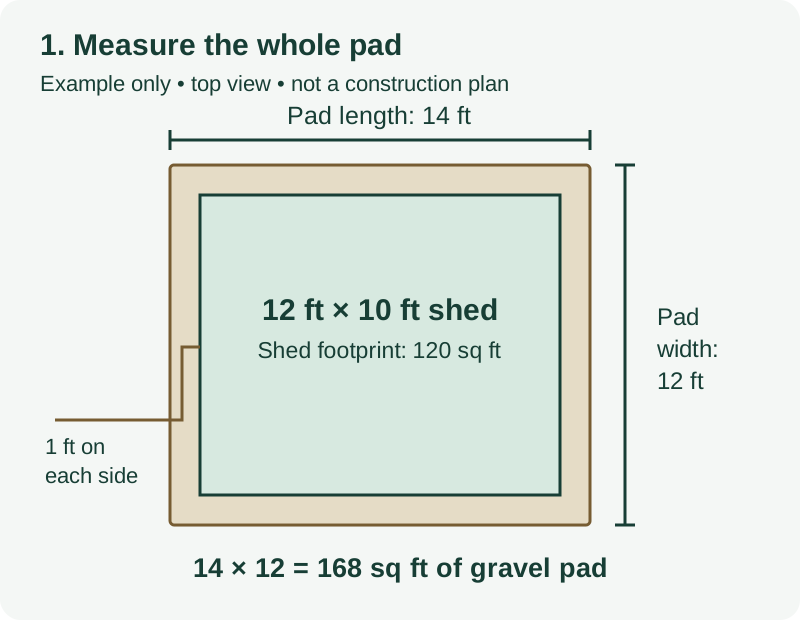
Follow the same example used in the printable worksheet: a 12 ft long × 10 ft wide shed with a 1 ft extension at the front, back, left and right. We use a 4 in finished gravel depth, 15% compaction allowance and 5% waste. These are sample inputs for learning the calculation, not recommended foundation specifications. Confirm your dimensions, material, depth and allowances with your shed provider and supplier.
Write 12 + 1 + 1 = 14 ft for pad length and 10 + 1 + 1 = 12 ft for pad width. Multiply 14 × 12 to get 168 sq ft. Using only the 120 sq ft shed footprint would miss 48 sq ft of this pad.
From Finished Depth to Loose Gravel
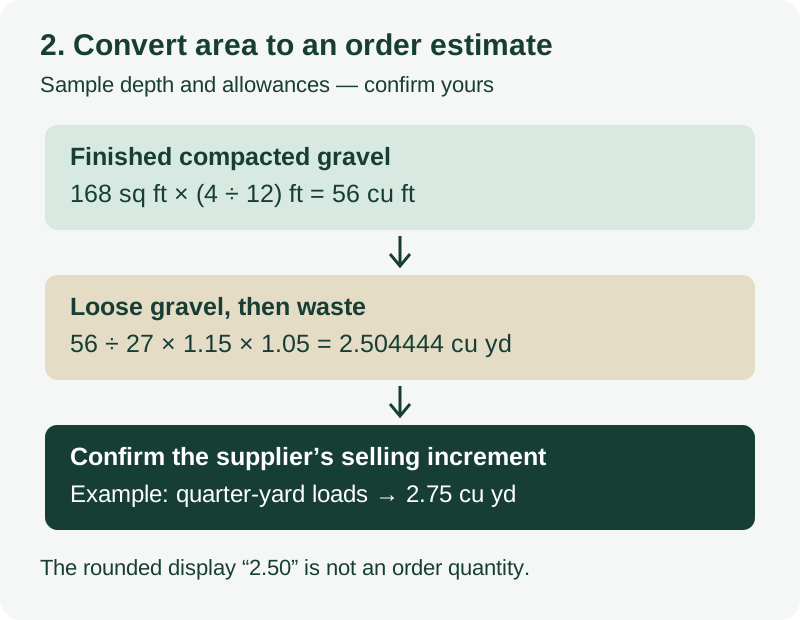
Convert the example finished depth before multiplying: 4 in ÷ 12 = one-third of a foot. The compacted volume is 168 × (4 ÷ 12) = 56 cu ft, or 56 ÷ 27 = 2.074074 cu yd. This is the volume after compaction, not the loose delivery quantity.
Apply the example allowances in sequence: 2.074074… × 1.15 = 2.385185… cu yd of loose gravel; then × 1.05 = 2.504444… cu yd including waste. Keep full precision through the calculation. Confirm whether a supplier quote already includes these allowances so you do not add them twice.
Complete the Worksheet: Estimate vs. Supplier Quote
| Worksheet entry | Calculated estimate | Example supplier order |
|---|---|---|
| Gravel quantity | 2.504444… cu yd | 2.75 cu yd if sold in 0.25 cu yd increments |
| Hypothetical gravel price | $40 per cu yd | $40 per cu yd |
| Gravel cost | $100.18 | $110.00 |
| Hypothetical delivery | $100.00 | $100.00 |
| Subtotal | $200.18 | $210.00 |
| With 10% contingency | $220.20 | $231.00 |
Check the Quote Before Placing the Order
The $220.20 figure matches the worksheet and calculator using the unrounded estimate. If a supplier only sells quarter-yard increments, round up: ceiling(2.504444… ÷ 0.25) × 0.25 = 2.75 cu yd. At the same sample price and delivery fee, the partial budget becomes (2.75 × $40 + $100) × 1.10 = $231.00. Record this confirmed quantity separately from the calculator estimate; a displayed 2.50 cu yd must not be rounded down into a short order.
These prices and selling increments are hypothetical, not a local quote. Ask the supplier to confirm the exact material, loose-volume or weight unit, minimum load, order increments, delivery access, fees and tax. If buying by weight, use that supplier’s loose bulk density rather than a universal conversion.
This budget includes only gravel, the sample delivery charge and contingency. Fabric, edging, excavation, labor, equipment, drainage, anchoring, permits and tax are not included. Record separately quoted items on the worksheet before comparing a contractor’s installed price.
Print the blank worksheet and fill in your own confirmed inputs
How Much Does a Gravel Shed Foundation Cost?
Start with your gravel order quantity and a current local supplier quote. Price by cubic yard or cubic meter, or use supplier-confirmed loose density to price by US short ton or metric tonne. Add fabric and perimeter materials only if included in your plan, add delivery, and apply your selected contingency. This is a partial material budget; labor, excavation, equipment, drainage, permits and tax need separate quotes.
Worked example, not recommended dimensions or market prices: a 12 ft × 10 ft shed with 1 ft extensions gives a 14 ft × 12 ft pad. At 4 in finished gravel depth, 15% compaction allowance and 5% waste, the order is 2.504444 cu yd. At a hypothetical $40 per cu yd, gravel costs $100.18. Add $100 delivery for a $200.18 subtotal; a 10% contingency brings the partial estimate to $220.20. The calculator uses unrounded quantities and rounds displayed money to cents.
Ask the supplier whether the quote includes delivery, a minimum load or a small-order fee. A rounded display of 2.50 cu yd is not a supplier order increment. Confirm the actual purchase quantity before ordering.
Estimate shed foundation gravel and cost with your own quote
Switch Units Without Changing the Project or Budget
The unit toggle converts your current measurements, supplier density, concrete bag yield and volume or weight prices. It retains the foundation method, support and skid counts, percentage allowances, prices per physical item, delivery and fixed material allowances. Blank optional quotes stay blank. This is a measurement conversion, not a currency exchange or a substitution of local products.
The gravel cost example above becomes a 4.2672 m × 3.6576 m pad with 10.16 cm compacted depth. The same gravel order is about 1.915 m³. The $40 per cu yd quote converts to about $52.32 per m³; the calculator retains more precision internally, so the gravel cost remains $100.18 and the partial estimate with delivery and contingency remains $220.20.
US short tons and metric tonnes are different units: 1 short ton = 0.90718474 tonnes. Both the supplier density and price per weight must convert together. Likewise, a concrete bag yielding 0.6 cu ft yields 16.9901079552 L; switching units keeps the same bag count and price per bag. Enter a different product’s actual dimensions, yield and quote separately.
Common Shed Foundation Methods
A compacted gravel pad estimates excavation, aggregate and optional fabric or edging. A gravel pad with skids adds stock timber for a manufacturer-specified floor support. A concrete slab with gravel base adds concrete and user-entered budget allowances. A block or pier grid counts a user-supplied layout. Engineered helical piles and specialty systems require their approved product workflow.
Each has planning advantages and limitations. Shed size, instructions, soil, drainage, frost, wind, anchorage, use and local rules determine suitability; no method is universally correct.
Foundation Methods and Materials Estimated
| Method | Estimated Materials | Additional Review |
|---|---|---|
| Compacted gravel pad | Gravel, fabric, perimeter material | Depth, drainage, soil and restraint detail |
| Gravel pad with skids | Pad materials and skid stock | Skid size, treatment, spacing and connections |
| Concrete slab | Base gravel, concrete and entered allowances | Thickness, reinforcement, joints, edges and frost |
| Block or pier grid | Units and optional small gravel pads | Bearing, grid, uplift and frost |
| Specialty system | Product-specific | Engineering, acceptance and installation |
Information Needed Before Estimating
Collect shed and foundation dimensions, four extensions, selected method, excavation and finished depth, compaction and waste, optional supplier density, slab geometry and published bag yield, confirmed skid or support layout, fabric and stock dimensions, and current prices.
The calculator estimates areas, volumes, loose order quantity, optional weight, rolls, stock pieces, bags, blocks and partial costs. It does not determine method, depths, reinforcement, bearing, support spacing, skid design, frost protection, anchorage or drainage.
Calculator Inputs by Mode
| Mode | Core Inputs |
|---|---|
| All modes | Shed size, four extensions, optional delivery and contingency |
| Gravel | Excavation, compacted depth, compaction, waste, optional density and prices |
| Skids | Gravel inputs plus confirmed count, skid length and stock length |
| Slab | Slab size, thickness, base depth, concrete method and entered allowances |
| Grid | Rows, supports per row, extras, units per support and optional gravel pads |
Calculator Results by Mode
| Mode | Primary Results |
|---|---|
| Gravel | Excavation, compacted and loose volumes, weight, fabric and edging |
| Skids | Gravel results, finished skid length and whole stock pieces |
| Slab | Gravel base, concrete volume, bags or volume cost |
| Grid | Support locations, total units and optional gravel volume |
How to Calculate Foundation Dimensions
Pad length = shed length + front + back extensions. Pad width = shed width + left + right extensions. Area = length × width. Perimeter = 2 × (length + width).
A foundation may extend beyond the footprint, but required extensions vary. Enter every side separately. Hypothetical geometry only: a 12 ft × 10 ft shed with 1 ft on every side creates 14 ft × 12 ft; a 3.5 m × 3 m shed with 0.3 m on every side creates 4.1 m × 3.6 m. Neither is a recommendation.
How Much Gravel Is Needed?
Compacted gravel = foundation area × compacted depth. Loose order volume = compacted volume × (1 + compaction allowance ÷ 100). Final order = loose volume × (1 + waste ÷ 100). Convert inches to feet and divide cu ft by 27 for cu yd; convert centimeters to meters and multiply m³ by 1,000 for L.
Excavation is in-place geometry. Finished compacted volume is the installed material. Loose volume accounts for reduction during compaction, and waste-adjusted volume is the order target. Behavior varies with aggregate, moisture and equipment.
Compacted and Loose Gravel Volume
| Stage | Formula or Meaning |
|---|---|
| Excavation volume | Foundation area × excavation depth |
| Finished compacted volume | Area × confirmed finished gravel depth |
| Loose volume | Compacted volume × entered compaction allowance |
| Final order volume | Loose volume × entered waste allowance |
Converting Gravel Volume to Weight
Estimated weight = final volume × supplier-confirmed density, using tons per cu yd or tonnes per m³. Density varies with aggregate, gradation, moisture, compaction, supplier and fines. The calculator shows no weight without density; supplier scale weight may differ.
Factors Affecting Gravel Density
| Factor | Why It Matters |
|---|---|
| Aggregate and gradation | Particle size and voids differ |
| Moisture and fines | Change measured mass and packing |
| Source and contamination | Product composition varies |
| Supplier measurement | Scale and volume methods differ |
Compaction Allowance vs. Waste
Compaction allowance covers loose material reducing in volume. Waste covers handling loss, grade correction, spillage and small measurement differences. Calculate compacted volume, apply compaction once, then waste once. Applying either twice overstates the order; no percentage suits every project.
Excavation and Removed Soil
Excavation = foundation area × excavation depth. Removed soil can loosen and expand, hauling volume can differ, and reuse depends on conditions. Wet or unsuitable soil can change the work. The calculator reports geometry only and does not predict hauling expansion.
Landscape Fabric and Perimeter Material
Fabric quantity depends on area, roll dimensions, strip direction, overlap, seams and waste. The calculator uses area-only roll coverage; include planned laps and cutting waste in the fabric allowance and check the strip layout separately. Perimeter = 2 × (length + width); waste-adjusted perimeter is divided by stock length and rounded up. Neither material is universally required.
Gravel Pads with Skids
Skids are longitudinal shed-floor supports. Count, size, treatment, orientation and spacing must come from the shed design. Pieces per skid = ceiling(skid length ÷ stock length); base pieces = pieces per skid × skid count; purchase quantity adds waste and rounds up. Each skid rounds separately because cutoffs may not transfer.
Concrete Slab Foundations
Slab area = length × width. Concrete = area × entered thickness; waste-adjusted concrete adds waste once. Base gravel uses the same compacted, loose and waste sequence. Reinforcement, vapor retarder, forms, joints, thickened edges, anchors and drainage can be entered only as budget allowances; structural quantities are not designed.
Concrete Bags vs. Ready-Mix
Bags = ceiling(waste-adjusted volume ÷ published volume yield per bag). Bag weight is not finished volume; confirm packaging or technical data. Larger quantities can be evaluated for ready-mix, considering minimums, access, placement time and equipment. No supplier or price is recommended.
Block or Pier Layouts
Grid supports = rows × supports per row. Total locations = grid supports + extras. Total units = locations × units per support. This counts a layout supplied by the user and never selects one. Floor framing, load distribution, bearing, frost, settlement, uplift and lateral movement matter; loose stacked blocks may be unsuitable or prohibited.
Worked Imperial Gravel-Pad Example
Hypothetical user inputs—not recommendations: a 12 ft × 10 ft shed, 1 ft extensions, 6 in excavation, 4 in compacted gravel, 15% compaction, 5% waste, supplier-entered density of 1.4 tons per cu yd, hypothetical $40 per cu yd, one 6 ft × 100 ft fabric roll and 8 ft edging stock.
Pad is 14 ft × 12 ft = 168 sq ft. Excavation is 84 cu ft (3.11 cu yd). Compacted gravel is 56 cu ft (2.07 cu yd); loose volume is 2.39 cu yd and final order is about 2.50 cu yd. Estimated weight is 3.51 US short tons and hypothetical gravel cost is $100.18, using unrounded quantities. Fabric area with 10% waste is 184.8 sq ft, requiring 1 roll. Perimeter is 52 ft; with 10% waste, 8 pieces of 8 ft edging are required.
Worked Metric Concrete Example
Hypothetical user inputs—not recommendations: a 3.5 m × 3 m slab, entered 10 cm thickness, 10 cm gravel base, 10% concrete waste, 15% gravel compaction, 5% gravel waste and published 17 L yield. Area is 10.5 m². Compacted base is 1.05 m³; loose and waste-adjusted order is about 1.268 m³. Concrete is 1.05 m³ before waste and 1.155 m³ (1,155 L) after waste, requiring 68 bags. Any price creates only a partial material cost.
Short Block-Grid Example
Hypothetical supplied grid—not a selected design: 2 rows × 3 supports plus 1 extra = 7 locations. At 2 units per support, total is 14. User-entered 0.6 m × 0.6 m gravel pads at 10 cm compacted depth total 0.252 m³ before compaction and waste. Unit and gravel prices can be added, but structural suitability is not evaluated.
Drainage, Grade, and Site Preparation
Water should not be trapped beneath or against a shed. Runoff, groundwater, low areas, expansive soil and organic or unsuitable material can change the approach. A level surface is not automatically an adequate foundation. Significant drainage or soil issues need qualified help.
Frost, Soil, Anchoring, and Local Requirements
Frost movement, bearing, settlement, expansive soil, wind uplift, anchorage, seismic conditions, setbacks, boundaries, easements, permits and inspections depend on location and project. Confirm through appropriate professionals and authorities; this is not legal, surveying or engineering advice.
Factors Affecting Foundation Selection
| Factor | Potential Effect |
|---|---|
| Shed size, weight and floor | Changes loads and support needs |
| Soil and groundwater | Changes bearing, settlement and drainage |
| Frost and climate | Changes movement and protection requirements |
| Wind and seismic conditions | Changes anchorage and lateral requirements |
| Manufacturer and local rules | Control accepted methods and inspections |
Imperial and Metric Volume Conversions
| Conversion | Relationship |
|---|---|
| Inches to feet | in ÷ 12 = ft |
| Cubic feet to cubic yards | cu ft ÷ 27 = cu yd |
| Centimeters to meters | cm ÷ 100 = m |
| Cubic meters to liters | m³ × 1,000 = L |
Items Excluded From the Estimate
| Excluded Item | Reason |
|---|---|
| Foundation and structural design | Requires project-specific loads and conditions |
| Drainage and grading design | Requires site evaluation |
| Labor, excavation and hauling | Site and contractor scope varies |
| Permits, inspections and tax | Local requirements vary |
| Anchorage and reinforcement quantities | Must follow approved design |
Common Shed-Foundation Estimating Mistakes
Common errors include using only the shed footprint, forgetting extensions, mixing units, confusing compacted and loose volume, applying allowances twice, using unverified density, ignoring excavation, overlap or drainage, combining skid footage before rounding, calculating bags from weight, letting a calculator select slab thickness or pier spacing, ignoring frost or soil, omitting logistics, digging before utility location, and treating quantities as a permit-ready plan.
Shed Foundation Planning and Buying Tips
Confirm the shed model and instructions, method and dimensions first. Measure elevation and drainage. Ask suppliers for density and delivery units, confirm concrete yield, compare bag and ready-mix logistics, verify fabric and stock sizes, confirm permits, setbacks and anchorage, locate utilities, recheck measurements and retain supplier quotes.
Shed Foundation Safety and Project Disclaimer
This guide and calculator estimate materials only and do not select or approve a foundation, soil bearing, drainage, frost protection, slab design, support spacing, anchorage, wind or uplift resistance, or capacity. Shed dimensions, weight, use, floor system, instructions, terrain, groundwater, soil, climate and local rules can change the design. Follow manufacturer requirements, approved plans, permits, setbacks and inspections. Locate underground utilities and properly verify boundaries and setbacks. Consult a qualified installer, manufacturer, professional or authority where appropriate. No example is structurally approved, code-compliant or permit-ready.
Get an instant estimate with the Shed Foundation Calculator
Estimate gravel, concrete, skids, blocks or piers, fabric, perimeter material, allowances and optional material costs from project-confirmed inputs.
Frequently Asked Questions
How much gravel do I need for a shed foundation?
Multiply confirmed area by compacted depth, then apply compaction and waste once.
How do I calculate gravel-pad dimensions?
Add separate front, back, left and right extensions to shed dimensions.
How deep should a gravel shed pad be?
Depth must be confirmed for the shed and site.
Does the calculator determine required gravel depth?
No.
What is a compaction allowance?
An entered factor converting compacted volume to loose order volume.
Should I add both compaction and waste?
They cover different effects and are applied sequentially when appropriate.
How many tons of gravel do I need?
Multiply final volume by supplier-confirmed density.
Why does gravel density vary?
Aggregate, gradation, moisture, fines and source vary.
Do I need landscape fabric?
Not universally; follow the approved site detail.
How much concrete is needed for a shed slab?
Multiply entered area by entered thickness and add waste.
How many concrete bags do I need?
Divide volume by published yield and round up.
Does the calculator determine slab thickness?
No.
How many skids does a shed need?
Use the manufacturer or approved design quantity.
How many blocks or piers does a shed need?
Enter a confirmed grid; the calculator only counts it.
Does the calculator determine support spacing?
No.
Can a shed sit directly on gravel?
Only when the selected shed and approved design permit it.
How does drainage affect the foundation?
Water and grade can change preparation and method.
Does frost depth matter?
It can materially change requirements.
Are permits or anchors required?
Confirm locally and with the shed manufacturer.
Is this estimate a construction or permit-ready plan?
No.